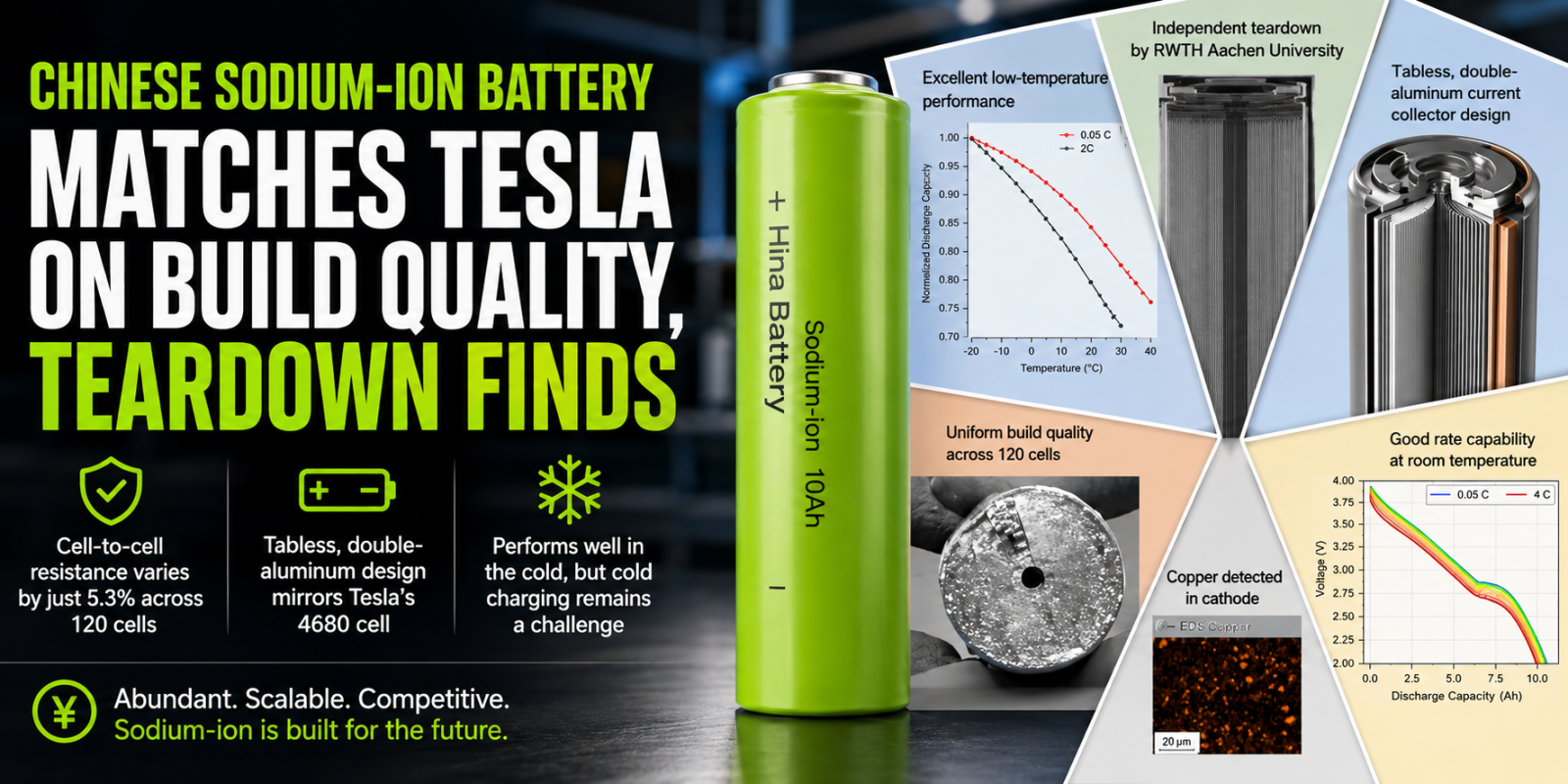
Chinese Sodium Ion Battery Matches Tesla In Build Quality According To Teardown Analysis
June 22, 2026
Share
Key Takeaways
A recent study found that Chinese manufacturer Hina's sodium-ion battery matches Tesla's lithium-ion cells in terms of manufacturing quality and internal design, with potential implications for the Canadian electric vehicle (EV) market and EV adoption.
The Hina sodium-ion battery has a lower energy density compared to leading lithium-ion technology, but its structural cost advantage and uniform temperature distribution make it suitable for applications like stationary storage, shorter-range EVs, and commercial electric vehicles.
Canadian consumers can expect to see more sodium-ion battery options become available in the market, with potential cost savings and improved performance, and the Canadian government's iZEV incentives and provincial rebates, such as Ontario's $5,000 rebate, could help make sodium-ion battery-powered EVs more competitive.
Canadian Implications of Sodium-Ion Battery Technology
A recent independent teardown of a commercial sodium-ion battery from Chinese manufacturer Hina has revealed that it matches Tesla's lithium-ion cells in terms of manufacturing quality and internal design. This study, conducted by researchers at Germany's RWTH Aachen University, has significant implications for the Canadian electric vehicle (EV) market, particularly in the context of the Canadian government's iZEV incentives and provincial rebates. While the Hina sodium-ion battery has lower energy density compared to leading lithium-ion technology, its structural cost advantage and uniform temperature distribution make it an attractive option for certain applications, such as stationary storage and shorter-range or commercial vehicles.
Manufacturing Quality and Design
The study found that the Hina sodium-ion battery has a "tabless, double-aluminum current collector design" that reduces resistance and ensures uniform temperature distribution, similar to Tesla's 4680 cell. This design feature is a significant advantage, as it allows for the use of aluminum current collectors on both sides of the cell, reducing costs. The researchers were impressed by the uniformity of the cells, with a cell-to-cell resistance varying by just 5.3% across 120 cells. This level of consistency is typically only achieved through mature production lines, rather than lab-scale manufacturing. Canadian companies looking to integrate sodium-ion batteries into their products may be able to take advantage of this technology, potentially reducing costs and improving performance.
Energy Density and Cold-Weather Charging
While the Hina sodium-ion battery has made significant strides in terms of manufacturing quality and design, it still lags behind leading lithium-ion technology in terms of energy density. This means that sodium-ion batteries are better suited for applications such as stationary storage, grid services, and shorter-range or commercial vehicles, rather than long-range passenger EVs. Additionally, the researchers found that sodium-ion batteries have difficulty with cold-weather charging, which could be a concern for Canadian consumers who often face harsh winter conditions. However, companies like CATL are working to address these issues, with plans to launch sodium-ion batteries in EVs in 2026, targeting around 175 Wh/kg and roughly 600 km of range as the chemistry matures.
Canadian Availability and Pricing
As the sodium-ion battery technology continues to evolve, Canadian consumers can expect to see more options become available in the market. While pricing has not been announced for the Canadian market, the cost advantage of sodium-ion batteries could make them an attractive option for consumers looking for a more affordable EV. Additionally, the Canadian government's iZEV incentives and provincial rebates could help make sodium-ion battery-powered EVs more competitive in the market. For example, the Ontario government offers a rebate of up to $5,000 for the purchase of an EV, which could help offset the cost of a sodium-ion battery-powered vehicle.
Conclusion
The recent study on Hina's sodium-ion battery has significant implications for the Canadian EV market. While the technology still has some limitations, its manufacturing quality and design are on par with leading lithium-ion technology. As companies like CATL continue to develop and refine sodium-ion battery technology, Canadian consumers can expect to see more options become available in the market. With the potential for cost savings and improved performance, sodium-ion batteries could play a significant role in the Canadian EV market, particularly in the context of the Canadian government's iZEV incentives and provincial rebates. As the technology continues to evolve, it will be important for Canadian companies and consumers to stay informed about the latest developments and advancements in sodium-ion battery technology.