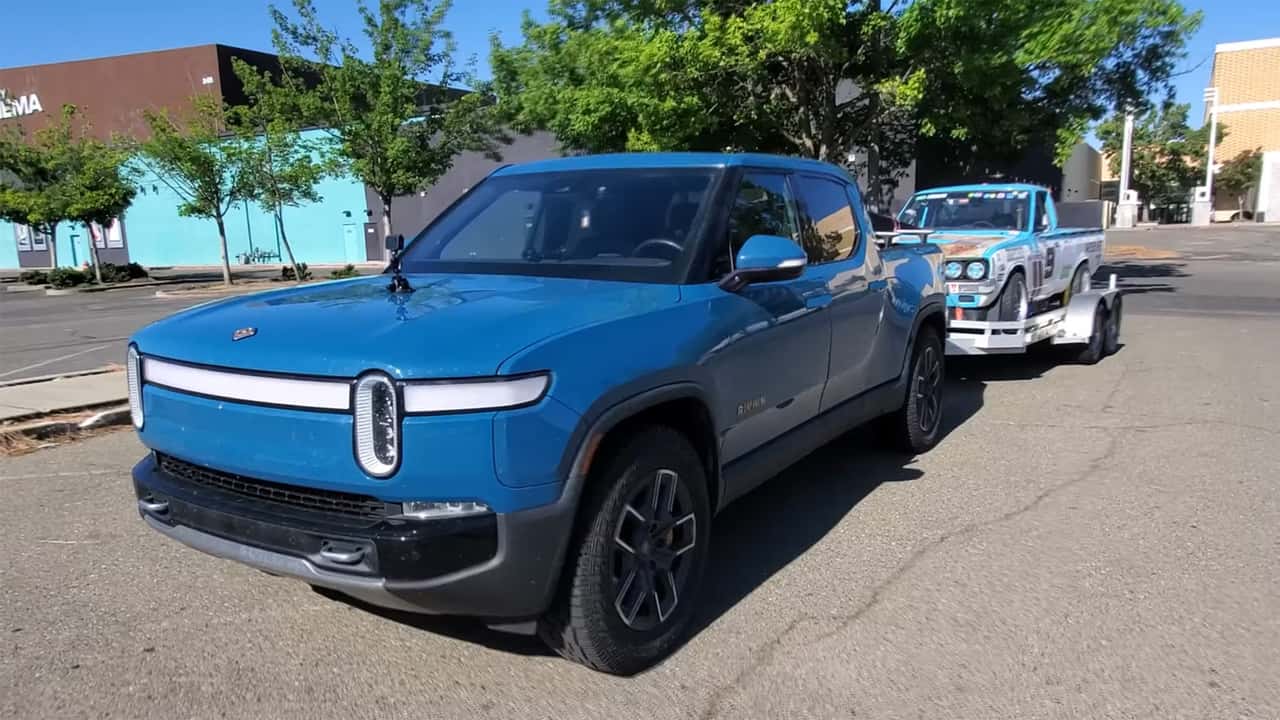
Rivian R1T Tows Large Trailer 1500 Miles with Lower Fuel Costs than Gasoline
June 15, 2026
Share
Key Takeaways
Electric vehicles, including the Rivian R1T, are proving their worth in towing capabilities, offering advantages like lower fuel costs and increased comfort, despite reduced range and more frequent charging stops, making them a viable option for Canadian EV drivers.
The Rivian R1T, with its 130-kilowatt-hour battery pack, achieved a realistic range of 160-170 miles between charging stops while towing a 4,500-pound trailer, resulting in significant fuel cost savings, estimated to be around two-thirds less than gas-powered vehicles.
Canadians can take advantage of incentives like the iZEV program, which offers a rebate of up to $5,000 for eligible electric vehicles, and provincial rebates for EV charging stations, making electric vehicle ownership more affordable and cost-effective for towing needs.
The Rivian R1T is expected to be available in the Canadian market soon, offering Canadians a powerful and capable electric towing option, with advanced features like regenerative braking and instant torque, well-suited to handle the country's rugged terrain and harsh weather conditions.
With the growing availability of electric vehicles in Canada, Canadians have more options than ever before to choose from, and can enjoy a more comfortable and cost-effective towing experience, with potential savings of hundreds of dollars, especially when considering the high cost of fuel in the country.
Electric Vehicles Prove Their Worth in Towing Capabilities, Even with Reduced Range
Electric cars are known to take a significant hit in range when towing substantial loads on long trips, resulting in more frequent charging stops and extended journey times. However, they still offer numerous advantages over gas trucks, including lower fuel costs and increased comfort. For Canadians, this is particularly relevant, as the country's vast distances and rugged terrain can make towing a challenging task. Despite the potential drawbacks, many Canadians are turning to electric vehicles for their towing needs, taking advantage of incentives such as the iZEV program, which offers a rebate of up to $5,000 for eligible electric vehicles.
A Real-World Example: Towing with a Rivian R1T
Tyler Joy, a member of the grassroots racing team Team Arcblast, recently embarked on a 1,500-mile journey from Denver, Colorado, to Thunderhill Raceway Park in Willows, California, towing a 4,500-pound trailer with a first-generation Rivian R1T Launch Edition. The quad-motor electric pickup, with its massive 130-kilowatt-hour battery pack, was able to achieve a realistic range of 160-170 miles between charging stops, resulting in 14 pit stops along the way. While this added approximately 10 hours to the trip duration, Tyler noted that the cost savings on fuel were significant, with estimates suggesting he spent only a third of what he would have on gas. For Canadians, this translates to a potential saving of hundreds of dollars, especially when considering the high cost of fuel in the country. Additionally, some provinces offer rebates for electric vehicle charging stations, making it even more cost-effective for Canadians to own and operate an electric vehicle.
The Benefits of Electric Towing
The Rivian R1T proved to be an excellent towing vehicle, thanks to its massive power reserve and regenerative braking capabilities. These features made steep climbs and long descents much more manageable, and the electric truck's comfort and quietness made the journey more enjoyable. While the reduced range and increased charging stops may be a drawback for some, Tyler found that the benefits of electric towing far outweighed the drawbacks. In the Canadian context, this is especially important, as the country's rugged terrain and harsh weather conditions can make towing a challenging task. Electric vehicles, with their instant torque and regenerative braking, are well-suited to handle these conditions, making them an attractive option for Canadians who need to tow heavy loads.
Optimizing Electric Towing for Canadian Drivers
To optimize electric towing for Canadian drivers, it's essential to consider the country's unique conditions, such as cold temperatures and rugged terrain. By taking advantage of incentives such as the iZEV program and provincial rebates, Canadians can make electric vehicle ownership more affordable. Additionally, by choosing electric vehicles with advanced towing capabilities, such as the Rivian R1T, Canadians can enjoy a more comfortable and cost-effective towing experience. With the growing availability of electric vehicles in Canada, including the Rivian R1T, which is expected to be available in the Canadian market soon, Canadians have more options than ever before to choose from. As the electric vehicle market continues to evolve, it's likely that we'll see even more innovative solutions for electric towing, making it an attractive option for Canadians who need to tow heavy loads.