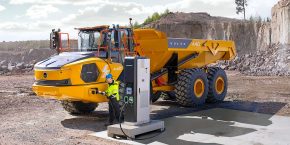
Electric Articulated Haul Trucks Enter Mass Production Series Video
April 11, 2026
Share
Key Takeaways
Volvo CE has begun serial production of the A30 and A40 Electric articulated haul trucks, marking the world’s first for electric vehicles of this size in heavy-duty applications.
The A30 Electric offers a payload capacity of 64,000 lb (29 tonnes) with a 245 kWh battery, while the A40 Electric provides 86,000 lb (39 tonnes) with a 324 kWh battery, both powered by 350 kW electric motors.
Initial deliveries will start in the UK and Norway, with further European distribution planned for late 2026, and potential future availability and incentives for Canadian industries through programs like Canada’s iZEV strategy.
Volvo CE has marked a significant milestone by beginning regular production of its A30 and A40 Electric articulated haul trucks, a world’s first for electric vehicles of this size transitioning from pilot stage to serial production. This achievement not only represents a breakthrough in the industrial segment for Volvo but also signifies a major step forward for battery electric vehicles (BEVs) in heavy-duty applications.
First showcased at last year’s Bauma construction show, the Volvo A30 Electric articulated hauler was anticipated as a revolutionary entry in both Volvo’s key industrial segment and the broader electric vehicle market. The realisation of this promise now underscores Volvo CE’s commitment to leading the industry’s transformation towards electrification.
“Starting serial production of electric articulated haulers of this size is a proud moment for Volvo CE,” states Melker Jernberg, President of Volvo CE. “It demonstrates our dedication to executing our vision of industry transformation. This milestone confirms that electric solutions are capable of meeting the rigorous demands of heavy, high-productivity applications, signalling that substantial change is already in motion.”
The Volvo A30 Electric provides a payload capacity of 64,000 lb. (29 tonnes) or 23.3 cubic yards, with “full day” operational capability powered by its 245 kWh li-ion battery pack. The A40 Electric extends this performance with an 86,000 lb. (39 tonnes) or 31 cubic yard payload capacity, supported by a larger 324 kWh battery. Both models are driven by identical 350 kW (~470 hp) electric motors, coupled with a torque-amplifying gear reduction gearbox. The peak “at the wheel” torque exceeds 200,000 lb-ft, ensuring performance parity with diesel counterparts and potentially influencing the rotational speed of the planet itself.
Charging for both the A30 and A40 Electric haul trucks utilise conventional CCS technology, enabling rapid charging speeds of up to 200 kW. This swift charging capability allows for a 10-80% charge between operator shift changes, a game-changer in the realm of electric construction and mining equipment.
The initial production units will be delivered to customers in the UK and Norway in the upcoming weeks, with further distributions planned for select European markets in the latter half of 2026. Although not currently available in Canada, this development signals potential future opportunities for Canadian industries seeking electric solutions.
For Canadian industries, the advent of such advanced electric machinery could herald significant benefits, particularly with various provincial incentives and rebates designed to promote the adoption of zero-emission vehicles. Programs such as Canada’s iZEV (Innovative Zero-Emission Vehicle) strategy offer substantial financial support for businesses transitioning to electric fleets, potentially making these Volvo haul trucks more accessible in the future.
The articulated hauler segment holds special significance for Volvo CE, as the company pioneered this class with the introduction of “Gravel Charlie,” the industry’s first articulated haul truck, back in 1966. This heritage infuses the company’s engineers with a profound sense of pride and responsibility, ensuring meticulous attention to detail in bringing this innovation to market.
“There is a genuine sense of pride in witnessing this transition from ambition to reality,” remarks Fredrik Tjernström, an Electromobility Solutions Sales expert at Volvo CE. “It’s not just about being first; it’s about fulfilling our promises. The customer interest we’ve observed since Bauma has been robust, surpassing even our initial production forecasts.”
As industries globally continue to explore and adopt electric solutions, developments such as Volvo’s A30 and A40 Electric haul trucks pave the way for a more sustainable future in heavy-duty applications. Canadian businesses are encouraged to stay informed about evolving electric vehicle offerings and available incentives, positioning themselves to benefit from the ongoing shift towards electrification in industrial operations.