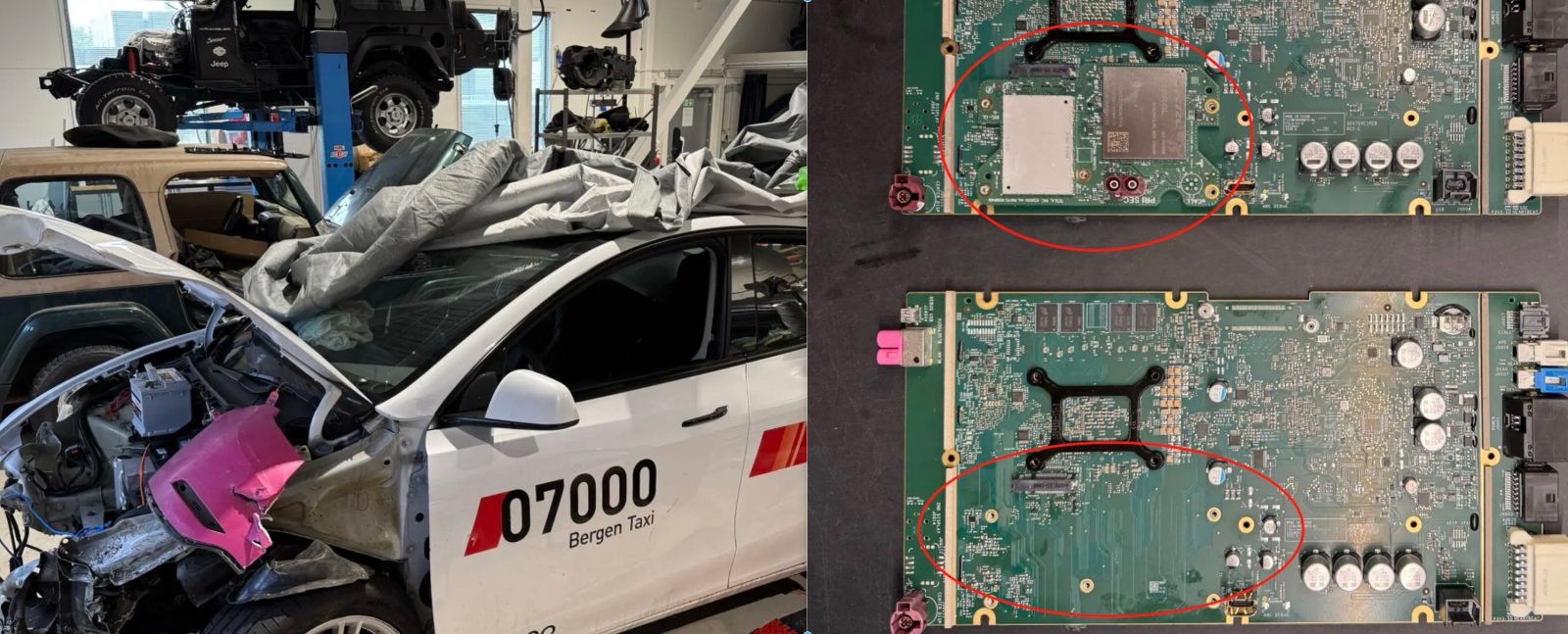
A critical network card, essential for storing and transmitting crash data, was stolen from a Tesla Model Y involved in a 2023 crash in Bergen, Norway, complicating the investigation.
The missing data could have provided insights into the six seconds of unaccounted-for data between two collisions, where independent experts suggest electronic malfunctions could mimic accelerator input.
The incident raises concerns for Canadian EV owners regarding the integrity of event data recorders, though Canada offers substantial incentives like Ontario’s $13,000 iZEV rebate and British Columbia’s $4,000 rebate to promote EV adoption.
Missing Evidence Complicates Tesla Model Y Crash Investigation in Norway
A critical piece of evidence — the network card responsible for storing and transmitting crash data — has been stolen from a Tesla Model Y involved in a violent crash in Bergen, Norway. This development casts serious doubt on the integrity of the investigation into the 2023 incident, where the electric vehicle accelerated to 90 km/h, launched into the air, and crashed into a kiosk.
The Incident
In the early morning of May 13, 2023, a Tesla Model Y taxi crashed violently through Torgallmenningen, one of Bergen’s busiest public squares. Dashcam footage, first published by Motor.no, shows the vehicle reversing into a parking spot before suddenly accelerating forward, jumping the sidewalk, and smashing through the outdoor seating area of Lille Bar. After a brief pause, the car accelerated again, reaching 90 km/h as it raced down Torggaten. Two pedestrians fled into a nearby supermarket as the vehicle approached. The driver swerved, hit a monument base, then launched up stone steps and crashed into a Narvesen kiosk.
The Investigation
The driver, a 12-year veteran taxi operator who was not intoxicated, claimed from the start that “something was wrong with the car.” He was initially charged with negligent driving and had his licence suspended. Tesla’s event data recorder (EDR) indicated that the accelerator pedal was pressed throughout both collisions. However, Tesla admits it lacks six seconds of data from the interval between the first and second impacts, stating the vehicle stopped uploading data after the first collision.
Norway’s Road Authority (Statens vegvesen) attributed the discrepancies to the car’s automatic collision-avoidance braking system activating but being “overridden” by continued accelerator input. Independent experts, including Simen Huse — one of only five authorized Bosch CDR tool operators in Norway — and researchers from Sintef, argue that electronic malfunctions, software errors, or voltage spikes could produce the same accelerator signal without the driver pressing the pedal.
The Missing Network Card
In December 2024, Bergen police dismissed the criminal case, stating they could not establish with sufficient certainty that the accident resulted from driver error, nor could they rule out a technical malfunction. The driver was declared innocent.
However, a recent investigation by Motor.no has revealed that when the vehicle was sent to independent data analyst Simen Huse for examination, a critical piece of hardware was missing. The network card — the component that handles continuous data storage and transmission between the vehicle and Tesla’s servers — was gone from the main computer. This is the very component that would have stored or transmitted the data from those missing six seconds.
The vehicle was transported over 500 km from Bergen’s Road Administration facility to Huse’s lab in Østfold. Upon inspection, Huse found the dashboard area stripped, with multiple plastic fittings removed, loose screws scattered, and electrical connections severed. Most critically, the network card was missing.
Implications for Canadian EV Owners
While this incident occurred in Norway, it raises important questions for Canadian EV owners, especially those driving Teslas. The integrity of event data recorders is crucial for determining the cause of accidents and ensuring justice. In Canada, EV owners can benefit from several incentives and rebates to make going electric more affordable. Programs such as the iZEV (incentive for Zero-Emission Vehicles) program offer federal and provincial rebates that can significantly reduce the cost of purchasing an EV.
For instance, Ontario offers up to $13,000 through its iZEV program, while British Columbia provides a rebate of up to $4,000. These incentives, combined with falling battery costs and improving charging infrastructure, make EVs an increasingly attractive option for Canadian consumers.
Looking Ahead
The disappearance of the network card in this case underscores the need for robust data protection measures and transparent investigations. While there is no evidence to suggest foul play by Tesla, the incident highlights the importance of ensuring that all data remains intact and accessible for thorough analysis.
As Canadian municipalities and provinces continue to invest in EV infrastructure and incentives, incidents like this serve as a reminder of the importance of reliable data in maintaining public trust and safety in the burgeoning electric vehicle market.