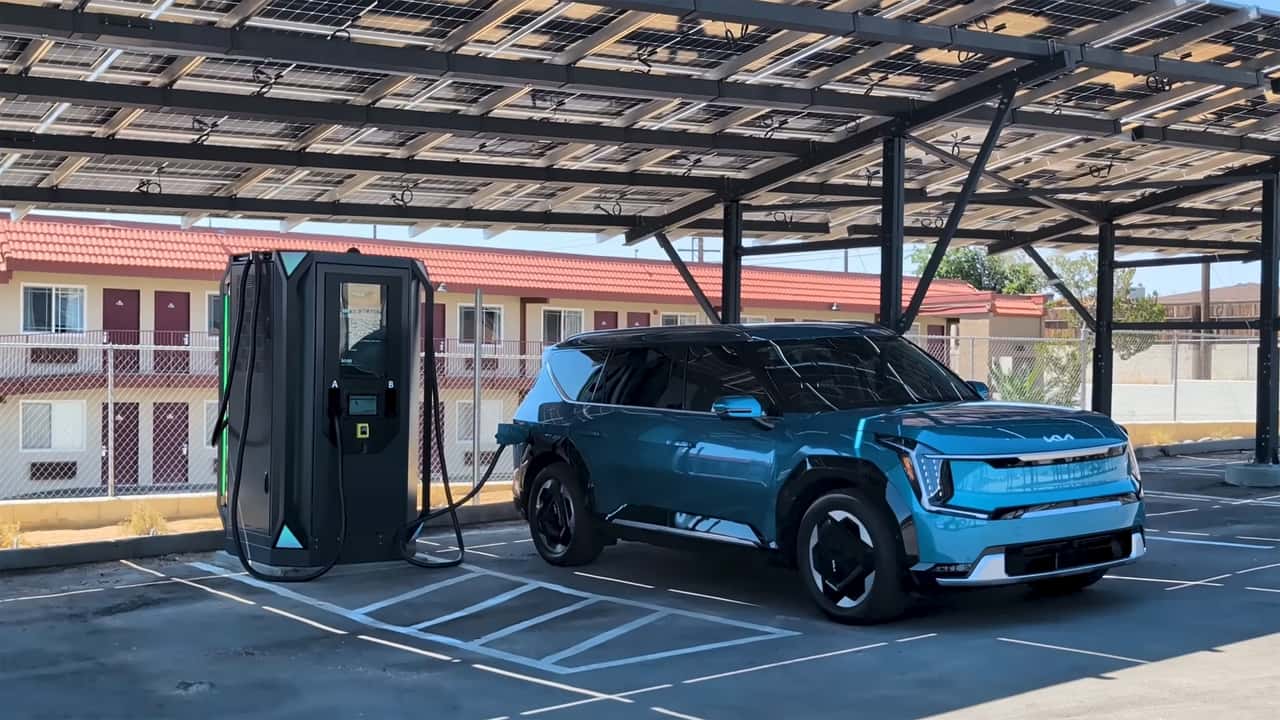
Off Grid EV Charging Station on Route 66 Offers Affordable Alternative
June 16, 2026
Share
Key Takeaways
A new solar-powered EV charging station has been unveiled in California, featuring 600 solar panels and three DC fast chargers capable of recharging up to six electric vehicles simultaneously, showcasing a potential model for Canada's electric vehicle market.
The Canadian pricing for solar-powered EV charging services is expected to be competitive, driven by cost savings from renewable energy sources and supported by government incentives such as the iZEV program and provincial rebates for electric vehicle adoption.
The solar-powered charging station's technical specifications, including integrated battery storage and up to 180 kilowatts of combined output, demonstrate its potential to meet the growing needs of Canada's EV market, particularly in remote areas where traditional grid connections may be limited.
Solar-Powered EV Charging Comes to the US, A Model for Canada
A new fast-charging location has been unveiled on historic Route 66 in California, powered entirely by solar energy. This innovative charging station, operated by Coral Charge, boasts a significant expansion over the company's first location, with roughly 600 solar panels and three DC fast chargers capable of recharging up to six electric vehicles simultaneously. Although this development is taking place in the US, it highlights the potential for similar solar-powered charging infrastructure in Canada, where the demand for environmentally friendly and efficient EV charging solutions is on the rise.
Canadian Context and Potential Applications
In the Canadian context, the adoption of solar-powered EV charging stations could be facilitated by the country's existing incentives, such as the iZEV program, which offers rebates for the purchase of electric vehicles. Additionally, provincial rebates and initiatives could further encourage the development of sustainable charging infrastructure. The Canadian pricing for such charging services would likely be competitive, considering the cost savings associated with renewable energy sources. As Canadian drivers increasingly turn to electric vehicles, the demand for convenient and environmentally conscious charging options will continue to grow, making solar-powered charging stations an attractive solution.
Technical Specifications and Efficiency
The charging dispensers, manufactured by Turkey's Imecar, feature integrated battery storage with up to 140 kilowatt-hours of energy reserved for periods when solar power is not available. This innovative design allows for a combined output of up to 180 kilowatts, making it an efficient and reliable option for EV drivers. The station's capacity to charge up to six vehicles at once, with both CCS1 and NACS plugs available, demonstrates its potential to meet the growing needs of the Canadian EV market, where drivers often travel long distances and require convenient charging options.
Advantages and Future Expansion
The use of solar power in EV charging stations offers numerous benefits, including reduced reliance on the grid and lower operating costs. This model could be particularly well-suited for Canada's vast and remote areas, where traditional grid connections may be limited or costly. Coral Charge's ability to install new charging stations in approximately eight weeks, compared to the typical 50 weeks required for grid-reliant stations, underscores the potential for rapid expansion and deployment of solar-powered EV charging infrastructure across Canada. As the country continues to invest in sustainable energy solutions and EV adoption, the development of similar charging stations could play a significant role in supporting the growth of Canada's electric vehicle market.