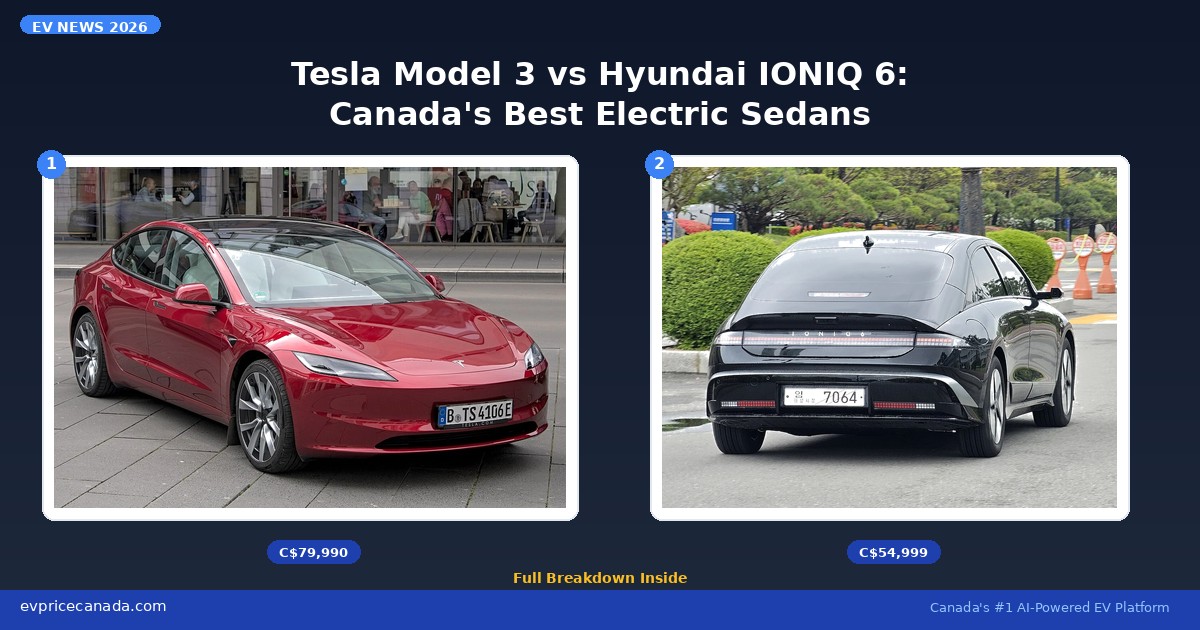
Tesla Model 3 vs Hyundai IONIQ 6: Canada's Best Electric Sedans Compared
April 16, 2026
Share
Quick Comparison
Hyundai IONIQ 6 has a more affordable starting price
Tesla Model 3 has a more powerful motor
Hyundai IONIQ 6 has a longer range
Tesla Model 3 has a more comprehensive charging network
Both vehicles are eligible for federal and provincial rebates
If you want the best range per dollar, the Hyundai IONIQ 6 has the edge — but the Tesla Model 3 pulls ahead on performance and brand prestige. The Hyundai IONIQ 6 is best suited for budget-conscious buyers who prioritize range and efficiency, while the Tesla Model 3 is ideal for those who value speed, technology, and a comprehensive charging network. Not sure which to pick? Try the EV comparison tool to see them side by side.
Both vehicles have their strengths and weaknesses, and the right choice will depend on your individual needs and preferences. In this article, we'll delve into the key differences between the Hyundai IONIQ 6 and the Tesla Model 3, covering range, charging, features, and more.
Whether you're a first-time EV buyer or a seasoned owner looking to upgrade, this comparison will help you make an informed decision. So let's dive in and explore what each vehicle has to offer.
{{vehicle:hyundai-ioniq-6-preferred-rwd-long-range-price-in-canada:topSpeed}} km/h
{{vehicle:tesla-model-3-long-range-awd-price-in-canada:topSpeed}} km/h
DC Fast Charge
18 min (10-80%)
N/A
Max DC Power
233 kW
250 kW
DC Port
CCS1
NACS
Seats
5
5
V2L
Yes
No
Range
When it comes to range, the Hyundai IONIQ 6 offers an impressive {{vehicle:hyundai-ioniq-6-preferred-rwd-long-range-price-in-canada:range.claimed}} km, while the Tesla Model 3 provides a range of {{vehicle:tesla-model-3-long-range-awd-price-in-canada:range.claimed}} km. However, it's essential to consider real-world range in Canadian conditions, where cold weather can reduce range by 20-40%. The Hyundai IONIQ 6's heat pump can help mitigate this effect, but pre-conditioning while plugged in is still crucial for optimal range.
In terms of battery capacity, the Hyundai IONIQ 6 has a {{vehicle:hyundai-ioniq-6-preferred-rwd-long-range-price-in-canada:battery.capacity}} kWh battery, while the Tesla Model 3 boasts a {{vehicle:tesla-model-3-long-range-awd-price-in-canada:battery.capacity}} kWh battery. While the Tesla Model 3 has a more powerful motor, with {{vehicle:tesla-model-3-long-range-awd-price-in-canada:motor.power}} kW compared to the Hyundai IONIQ 6's {{vehicle:hyundai-ioniq-6-preferred-rwd-long-range-price-in-canada:motor.power}} kW, the Hyundai IONIQ 6's more efficient battery and range make it a compelling choice for those who prioritize range.
Charging
Both vehicles offer DC fast charging capabilities, but the Hyundai IONIQ 6 has a CCS1 port, while the Tesla Model 3 uses the NACS port. The Hyundai IONIQ 6 can charge from 10-80% in just 18 minutes, making it an excellent choice for long road trips. Canadian charging networks like FLO, Petro-Canada Electric Highway, and Electrify Canada provide extensive coverage, with typical DCFC costs ranging from C$0.35-0.55/kWh. In contrast, home charging costs around C$0.12/kWh, making it a more economical option for daily driving.
Tesla's Supercharger network is also a significant advantage, with its comprehensive coverage and fast charging speeds. However, the Hyundai IONIQ 6's more affordable price and longer range make it a more attractive option for budget-conscious buyers.
Features Face-Off
Feature
Hyundai IONIQ 6
Tesla Model 3
Sunroof / Panoramic Roof
No
No
Heated Front Seats
No
No
Heated Rear Seats
No
No
Heated Steering Wheel
No
No
Wireless Charging
No
No
Apple CarPlay
Yes
Yes
Android Auto
Yes
Yes
Navigation
No
No
Blind Spot Monitoring
No
No
Lane Keeping Assist
No
No
Adaptive Cruise Control
No
No
Automatic Emergency Braking
No
No
Rear Camera
Yes
Yes
360° Camera
No
No
Keyless Entry
No
No
OTA Updates
No
No
Heat Pump
No
No
V2L (Vehicle-to-Load)
Yes
No
DC Fast Charging
No
No
The Hyundai IONIQ 6 and Tesla Model 3 have distinct feature sets, with the Hyundai IONIQ 6 offering a more comprehensive suite of standard features. See the Features Face-Off table above for a full breakdown, but notable differences include the Hyundai IONIQ 6's Vehicle-to-Load (V2L) capability and heat pump. The Tesla Model 3, on the other hand, boasts a more premium interior and a larger touchscreen display.
While both vehicles have their strengths and weaknesses, the Hyundai IONIQ 6's more affordable price and longer range make it a compelling choice for those who prioritize practicality. However, the Tesla Model 3's more powerful motor and comprehensive charging network make it an excellent option for those who value performance and convenience.
Pros and Cons
Hyundai IONIQ 6 — Pros & Cons
Pro: Affordable price, with a starting price of {{vehicle:hyundai-ioniq-6-preferred-rwd-long-range-price-in-canada:formattedPrice}}
Pro: Impressive range of {{vehicle:hyundai-ioniq-6-preferred-rwd-long-range-price-in-canada:range.claimed}} km
Con: Less powerful motor, with {{vehicle:hyundai-ioniq-6-preferred-rwd-long-range-price-in-canada:motor.power}} kW
Tesla Model 3 — Pros & Cons
Pro: Powerful motor, with {{vehicle:tesla-model-3-long-range-awd-price-in-canada:motor.power}} kW
Pro: Comprehensive Supercharger network
Con: Higher price, starting at {{vehicle:tesla-model-3-long-range-awd-price-in-canada:formattedPrice}}
Our Verdict: Which Should You Buy?
Choose the Hyundai IONIQ 6 if you prioritize range and affordability. With its impressive range and lower price point, it's an excellent choice for budget-conscious buyers. However, if you value performance and a premium driving experience, the Tesla Model 3 is the better option.
Ultimately, the decision between the Hyundai IONIQ 6 and the Tesla Model 3 will depend on your individual needs and preferences. Consider your daily driving habits, budget, and priorities, and choose the vehicle that best aligns with your lifestyle.
If you're still undecided, consider the following tie-breaker: if you plan to drive primarily in urban areas and prioritize range, the Hyundai IONIQ 6 may be the better choice. However, if you frequently take long road trips or value the convenience of a comprehensive charging network, the Tesla Model 3 is the way to go.
A: The Hyundai IONIQ 6 is eligible for the federal iZEV rebate of C$5,000, as well as provincial rebates in certain regions. The Tesla Model 3 is not eligible for the federal rebate, but may be eligible for provincial incentives.
Q: How does winter weather affect range?
A: Cold weather can reduce range by 20-40%. However, the Hyundai IONIQ 6's heat pump and pre-conditioning capabilities can help mitigate this effect.
Q: Which charging network is more comprehensive?
A: Tesla's Supercharger network is one of the most extensive and convenient charging networks in Canada, with fast charging speeds and comprehensive coverage.
Q: Which vehicle suits my needs?
A: If you prioritize range and affordability, the Hyundai IONIQ 6 may be the better choice. However, if you value performance and a premium driving experience, the Tesla Model 3 is the way to go.
Q: Is the Hyundai IONIQ 6 eligible for the iZEV rebate?
A: Yes, the Hyundai IONIQ 6 is eligible for the federal iZEV rebate of C$5,000, as its starting price is under C$55,000.
Q: Can I charge my vehicle at home?
A: Yes, both vehicles can be charged at home using a Level 2 charger. The cost of home charging is typically around C$0.12/kWh, making it a more economical option for daily driving.