Tesla Model 3 vs Polestar 2: Premium Electric Sedans in Canada
April 16, 2026
Share
Quick Comparison
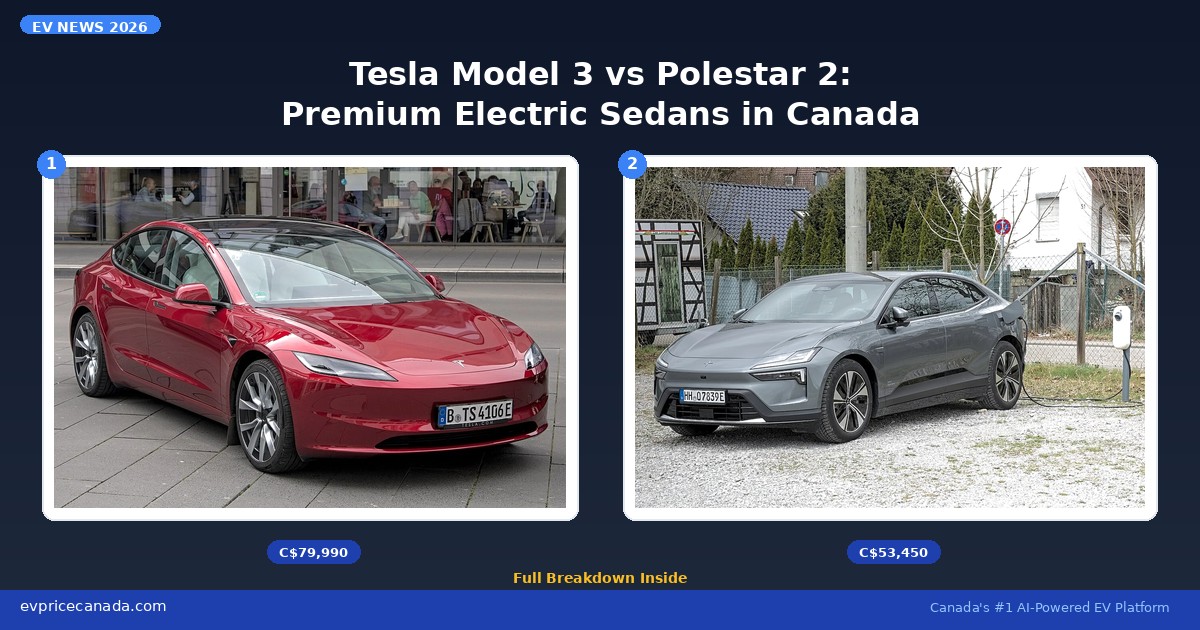
The Polestar 2 starts at $53,450, offering a competitive price point
The Tesla Model 3 starts at $79,990, with a focus on performance and range
Both vehicles have their unique selling points, from range to features
Cold weather can significantly impact range, with a 20-40% reduction possible
Charging networks like FLO, Electrify Canada, and Tesla's Supercharger are available for convenient long-distance travel
If you want the best range per dollar, the Polestar 2 has the edge — but the Tesla Model 3 pulls ahead on performance and features. The Polestar 2, priced at {{vehicle:polestar-2-standard-range-single-motor-price-in-canada:formattedPrice}}, is an attractive option for those prioritizing value without compromising on quality. On the other hand, the Tesla Model 3, with its {{vehicle:tesla-model-3-long-range-awd-price-in-canada:formattedPrice}} price tag, offers a more comprehensive package that includes superior acceleration and a wider range of features.
The decision between these two electric vehicles largely depends on what you value most: cost-effectiveness, performance, or the overall driving experience. Both vehicles have their strengths and weaknesses, which are discussed in detail below.
Not sure which to pick? Try the EV comparison tool to see them side by side.
{{vehicle:polestar-2-standard-range-single-motor-price-in-canada:topSpeed}} km/h
{{vehicle:tesla-model-3-long-range-awd-price-in-canada:topSpeed}} km/h
DC Fast Charge
28 min (10-80%)
N/A
Max DC Power
205 kW
250 kW
DC Port
CCS1
NACS
Seats
5
5
V2L
No
No
Range
The range of an electric vehicle is one of its most critical specifications. The Polestar 2 boasts a claimed range of {{vehicle:polestar-2-standard-range-single-motor-price-in-canada:range.claimed}} km, while the Tesla Model 3 offers {{vehicle:tesla-model-3-long-range-awd-price-in-canada:range.claimed}} km. However, it's essential to consider real-world range, especially in Canada's cold climate, where range can be reduced by 20-40%. The Tesla Model 3's larger battery, {{vehicle:tesla-model-3-long-range-awd-price-in-canada:battery.capacity}} kWh, provides a buffer against this reduction, but the absence of a heat pump in both models means they rely on less efficient resistive heating.
Pre-conditioning your vehicle while it's still plugged in can significantly mitigate the effects of cold weather on range. This feature allows the vehicle to warm up the battery and cabin using external power, ensuring that when you start your journey, your vehicle is at an optimal temperature without having drained its battery.
Charging
Charging capability is another crucial aspect of electric vehicle ownership. The Polestar 2 supports DC fast charging up to 205 kW, while the Tesla Model 3 can charge at speeds up to 250 kW. However, the Tesla Model 3 uses the NACS (North American Charging Standard) connector, which is exclusive to Tesla, whereas the Polestar 2 uses the more universally adopted CCS1 connector.
In Canada, several charging networks are available, including FLO with its extensive network of over 50,000 stations, the Petro-Canada Electric Highway, Electrify Canada, and Tesla's Supercharger network. The cost of charging varies, with home charging typically costing around C$0.12/kWh and public DC fast charging ranging from C$0.35 to C$0.55/kWh, depending on the network and location.
Features Face-Off
Feature
Polestar 2
Tesla Model 3
Sunroof / Panoramic Roof
No
No
Heated Front Seats
No
No
Heated Rear Seats
No
No
Heated Steering Wheel
No
No
Wireless Charging
No
No
Apple CarPlay
Yes
Yes
Android Auto
Yes
Yes
Navigation
No
No
Blind Spot Monitoring
No
No
Lane Keeping Assist
No
No
Adaptive Cruise Control
No
No
Automatic Emergency Braking
No
No
Rear Camera
Yes
Yes
360° Camera
No
No
Keyless Entry
No
No
OTA Updates
No
No
Heat Pump
No
No
V2L (Vehicle-to-Load)
No
No
DC Fast Charging
No
No
Both the Polestar 2 and the Tesla Model 3 come equipped with a range of features that enhance the driving experience. Notable among these are their infotainment systems, which support both Apple CarPlay and Android Auto. For a full breakdown of the features available on each model, see the Features Face-Off table above.
The Tesla Model 3 is known for its tech-savvy approach, with over-the-air updates that continuously improve the vehicle's software and features. Both vehicles lack certain comfort features like heated rear seats and a heated steering wheel in their base configurations, but they make up for this with their modern, sleek interiors and driver-centric designs.
Pros and Cons
Polestar 2 — Pros & Cons
Pro: Competitive pricing at {{vehicle:polestar-2-standard-range-single-motor-price-in-canada:formattedPrice}}
Pro: Efficient electric powertrain with {{vehicle:polestar-2-standard-range-single-motor-price-in-canada:motor.power}} kW of power
Con: Limited range of {{vehicle:polestar-2-standard-range-single-motor-price-in-canada:range.claimed}} km may not suit all users
Tesla Model 3 — Pros & Cons
Pro: Superior performance with {{vehicle:tesla-model-3-long-range-awd-price-in-canada:motor.power}} kW and {{vehicle:tesla-model-3-long-range-awd-price-in-canada:acceleration}}s 0-100 km/h
Pro: Longer range of {{vehicle:tesla-model-3-long-range-awd-price-in-canada:range.claimed}} km for less range anxiety
Con: Higher price point at {{vehicle:tesla-model-3-long-range-awd-price-in-canada:formattedPrice}}
Our Verdict: Which Should You Buy?
Choose the Polestar 2 if you're looking for a balance between affordability and the electric vehicle experience, without needing the absolute longest range or the fastest acceleration. Its competitive pricing and efficient powertrain make it an excellent value proposition.
Choose the Tesla Model 3 if performance and range are your top priorities. With its powerful motors and larger battery, it offers a driving experience that's hard to match in the electric vehicle segment. Additionally, its access to Tesla's Supercharger network can be a significant advantage for those who frequently take long trips.
For undecided buyers, consider your specific needs: if budget is a concern but you still want a premium electric sedan experience, the Polestar 2 might be the way to go. However, if you can stretch your budget and value the comprehensive package of performance, range, and features, the Tesla Model 3 is the better choice.
Q: Which vehicle is cheaper after federal and provincial rebates?
A: The Polestar 2, priced at {{vehicle:polestar-2-standard-range-single-motor-price-in-canada:formattedPrice}}, is eligible for the full C$5,000 federal iZEV rebate, as well as provincial rebates where applicable, making it the more affordable option after incentives.
Q: How does cold weather affect the range of these vehicles?
A: Cold weather can reduce the range of both vehicles by 20-40%. Pre-conditioning the vehicle while it's plugged in can help mitigate this effect.
Q: Which charging network is most convenient for long trips?
A: Tesla's Supercharger network is highly regarded for its convenience and coverage, especially for Tesla owners. For non-Tesla owners, networks like FLO and Electrify Canada offer extensive coverage across Canada.
Q: Which vehicle suits city driving better?
A: The Polestar 2, with its more compact size and front-wheel drive, might be more suited for city driving, though both vehicles are capable in urban environments.
Q: Is the Tesla Model 3 eligible for the federal iZEV rebate?
A: The Tesla Model 3, with a price of {{vehicle:tesla-model-3-long-range-awd-price-in-canada:formattedPrice}}, exceeds the C$55,000 MSRP limit for the federal iZEV rebate, making it ineligible for this incentive.