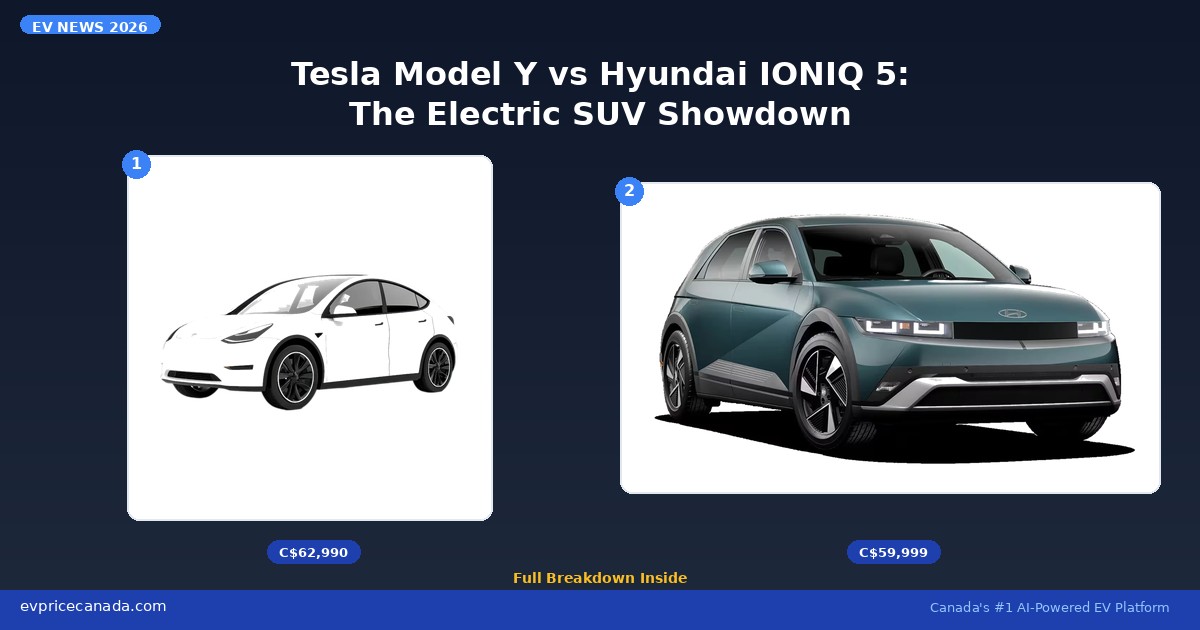
Tesla Model Y vs Hyundai IONIQ 5: The Electric SUV Showdown
April 16, 2026
Share
Quick Comparison
The Hyundai IONIQ 5 starts at C$59,999, while the Tesla Model Y starts at C$62,990
The IONIQ 5 has a claimed range of 488 km, while the Model Y has a claimed range of 533 km
The IONIQ 5 features a heat pump for more efficient heating, while the Model Y has a more powerful motor
Both vehicles offer DC fast charging capabilities, with the IONIQ 5 using a CCS1 port and the Model Y using a NACS port
The IONIQ 5 is eligible for the federal iZEV rebate of C$5,000, as well as provincial rebates
If you want the best range per dollar, the Hyundai IONIQ 5 has the edge — but the Tesla Model Y pulls ahead on performance and brand prestige. The IONIQ 5 is ideal for those prioritizing value and range, while the Model Y suits buyers seeking a premium experience and access to Tesla's extensive Supercharger network. Both vehicles are well-suited for Canadian roads, with all-wheel drive and decent ground clearance.
When deciding between these two electric SUVs, consider your priorities: range, price, features, and charging convenience. Not sure which to pick? Try the EV comparison tool to see them side by side.
In this comparison, we'll delve into the key aspects of both vehicles, including range, charging, features, and value, to help you make an informed decision.
{{vehicle:hyundai-ioniq-5-ultimate-awd-long-range-price-in-canada:topSpeed}} km/h
{{vehicle:tesla-model-y-long-range-awd-price-in-canada:topSpeed}} km/h
DC Fast Charge
18 min (10-80%)
15 min (10-80%)
Max DC Power
233 kW
250 kW
DC Port
CCS1
NACS
Seats
5
5
V2L
Yes
No
Range
The Hyundai IONIQ 5 boasts a claimed range of {{vehicle:hyundai-ioniq-5-ultimate-awd-long-range-price-in-canada:range.claimed}} km, while the Tesla Model Y offers {{vehicle:tesla-model-y-long-range-awd-price-in-canada:range.claimed}} km. However, real-world range in Canadian conditions can be affected by cold weather, with a 20-40% reduction in range. The IONIQ 5's heat pump can help mitigate this reduction, providing more efficient heating. Pre-conditioning your vehicle while plugged in can also help optimize range in cold temperatures.
Charging
Both vehicles offer DC fast charging capabilities, with the Hyundai IONIQ 5 using a CCS1 port and the Tesla Model Y utilizing a NACS port. The IONIQ 5 can charge from 10-80% in 18 minutes, while the Model Y can achieve the same in 15 minutes. Canadian charging networks like FLO, Petro-Canada Electric Highway, and Electrify Canada provide extensive coverage, with typical DC fast charging costs ranging from C$0.35-0.55/kWh. In contrast, home charging costs around C$0.12/kWh.
Features Face-Off
Feature
Hyundai IONIQ 5
Tesla Model Y
Sunroof / Panoramic Roof
No
No
Heated Front Seats
No
No
Heated Rear Seats
No
No
Heated Steering Wheel
No
No
Wireless Charging
No
No
Apple CarPlay
Yes
Yes
Android Auto
Yes
Yes
Navigation
No
No
Blind Spot Monitoring
No
No
Lane Keeping Assist
No
No
Adaptive Cruise Control
No
No
Automatic Emergency Braking
No
No
Rear Camera
Yes
Yes
360° Camera
No
No
Keyless Entry
No
No
OTA Updates
No
No
Heat Pump
No
No
V2L (Vehicle-to-Load)
Yes
No
DC Fast Charging
No
No
The Hyundai IONIQ 5 and Tesla Model Y offer a range of features, including tech, safety, and comfort amenities. See the Features Face-Off table above for a full breakdown. Notable differences include the IONIQ 5's Vehicle-to-Load (V2L) capability and the Model Y's larger battery capacity. The IONIQ 5 also features a more comprehensive standard features list, including a rear camera and Apple CarPlay/Android Auto integration.
Pros and Cons
Hyundai IONIQ 5 — Pros & Cons
Pro: Competitive pricing, with a starting price of {{vehicle:hyundai-ioniq-5-ultimate-awd-long-range-price-in-canada:formattedPrice}}
Pro: Impressive range of {{vehicle:hyundai-ioniq-5-ultimate-awd-long-range-price-in-canada:range.claimed}} km
Con: Less powerful motor, with {{vehicle:hyundai-ioniq-5-ultimate-awd-long-range-price-in-canada:motor.power}} kW
Tesla Model Y — Pros & Cons
Pro: Premium brand experience and extensive Supercharger network
Pro: Faster acceleration, with a 0-100 km/h time of {{vehicle:tesla-model-y-long-range-awd-price-in-canada:acceleration}}s
Con: Higher price point, starting at {{vehicle:tesla-model-y-long-range-awd-price-in-canada:formattedPrice}}
Our Verdict: Which Should You Buy?
Choose the Hyundai IONIQ 5 if you prioritize value, range, and a comprehensive standard features list. With its competitive pricing and impressive range, the IONIQ 5 is an attractive option for budget-conscious buyers.
Choose the Tesla Model Y if you prefer a premium brand experience, faster acceleration, and access to Tesla's extensive Supercharger network. While it comes at a higher price point, the Model Y offers a unique blend of performance, luxury, and convenience.
Ultimately, the decision between these two electric SUVs depends on your individual needs and preferences. Consider your budget, driving habits, and must-have features to make an informed decision.
A: The Hyundai IONIQ 5 is eligible for the federal iZEV rebate of C$5,000, as well as provincial rebates, making it the more affordable option.
Q: How does winter affect the range of these vehicles?
A: Cold weather can reduce the range of both vehicles by 20-40%. However, the Hyundai IONIQ 5's heat pump can help mitigate this reduction.
Q: Which charging network is most convenient?
A: The Tesla Supercharger network is one of the most extensive, with a large number of stations across Canada. However, other networks like FLO and Electrify Canada also offer convenient charging options.
Q: Which vehicle suits my needs?
A: If you prioritize value and range, the Hyundai IONIQ 5 may be the better choice. If you prefer a premium brand experience and faster acceleration, the Tesla Model Y is the way to go.
Q: Is the Hyundai IONIQ 5 eligible for the iZEV rebate?
A: Yes, the Hyundai IONIQ 5 is eligible for the federal iZEV rebate of C$5,000, as its starting price is under C$55,000.