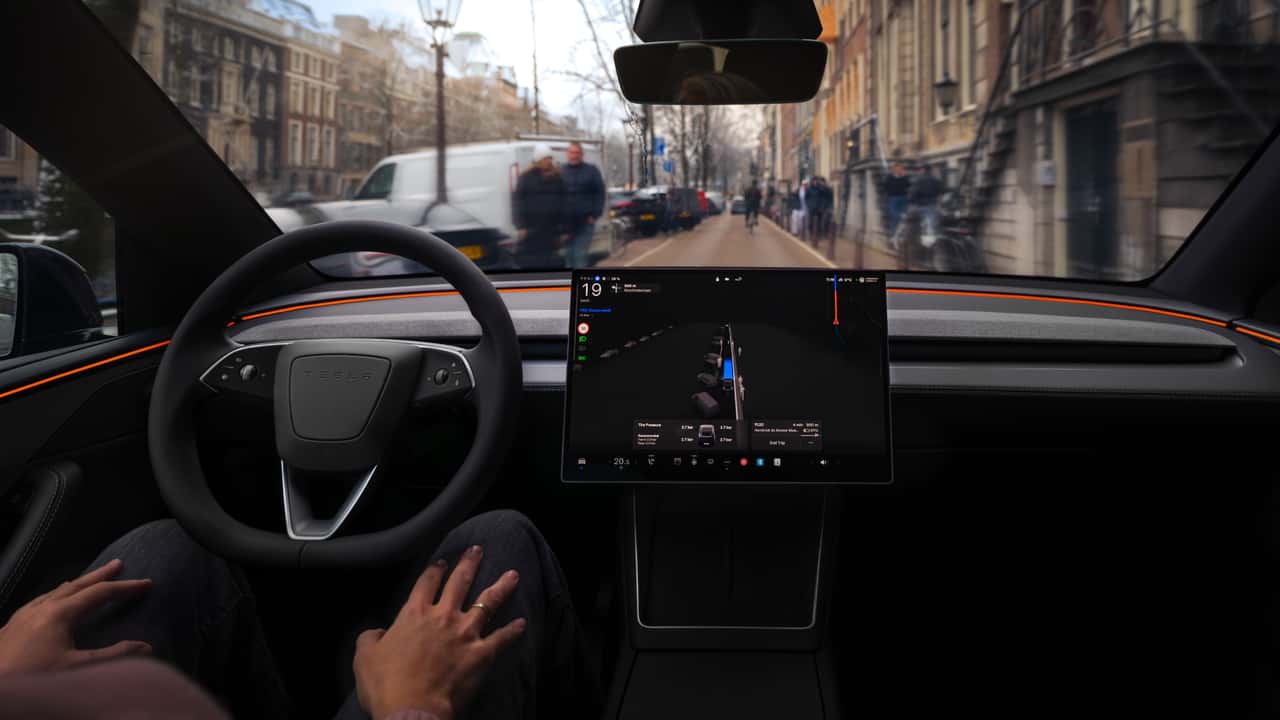
Tesla Autonomous Driving Gains European Approval But Not Nationwide Yet
April 12, 2026
Share
Key Takeaways
Tesla’s Full Self-Driving (FSD) (Supervised) has received approval in the Netherlands, marking a significant milestone for Tesla’s European expansion and setting the stage for broader EU acceptance.
The approval followed an extensive 18-month testing period, with Tesla submitting thousands of pages of documentation, conducting thousands of track tests, and completing dozens of safety studies.
Tesla claims FSD (Supervised) reduces collision risk by up to seven times compared to manual driving, though independent verification of these claims is still pending.
While the Netherlands approval is a major step, EU-wide approval requires further review and voting by member states; Canada lacks a widespread regulatory framework for supervised self-driving systems.
Canadian drivers can benefit from provincial EV incentives, including for vehicles equipped with advanced driver-assistance systems (ADAS), though supervised self-driving features are not yet widely regulated in the country.
Tesla’s Full Self-Driving (Supervised) Gains Approval in the Netherlands, Paving the Way for European Expansion
Tesla’s Full Self-Driving (FSD) (Supervised) has finally received approval for use in Europe, marking a significant milestone for the company. The Netherlands is the first European market to approve FSD (Supervised), following an extensive 18-month period of testing and analysis conducted by the Dutch vehicle authority, RDW. This approval serves as a breakthrough for Elon Musk, who had publicly expressed frustration over the delays, and it could open the door for broader European acceptance.
Extensive Testing and Documentation
The approval from RDW came after Tesla submitted an impressive amount of data and documentation. Over the past 18 months, Tesla has produced thousands of pages of documentation, conducted thousands of track test scenario executions, and completed dozens of research studies into safety performance and results. The company also provided demonstrations to regulators from almost every EU country. In an email announcement, Tesla stated, “For the past 18 months, Tesla has been working hard toward shipping FSD (Supervised) in Europe. Today’s announcement marks a significant milestone, opening the way to safer roads for all.”
Differences Between European and U.S. Certification Processes
The process for certifying self-driving systems like FSD in Europe differs significantly from that in the United States. In the U.S., automakers can essentially self-certify, with regulators stepping in only if issues arise. This flexibility allowed Tesla to use customer beta testers for years—customers paid thousands upfront to have FSD enabled in their vehicles before the service switched to a monthly subscription model. Such an approach would not be permissible in Europe, where the certification process is much more stringent.
According to *Not a Tesla App*, there are notable differences between the European and U.S. versions of FSD. For instance, instead of speed profiles labelled from 'Sloth' to 'Mad Max' as in the U.S., the European version features 'Max Speed' and 'Max Speed Offset' settings.
Evolution of Tesla’s FSD Beta
Tesla initially launched the FSD beta in October 2020, restricting access to Tesla employees and approved testers. By April 2022, the program had expanded to include over 100,000 active users. FSD remained in beta until April 2024, when version 12.3.3 was released as the first ‘supervised’ version. Despite the change in naming, the system was—and still is—incomplete.
Safety and Responsibility
Tesla emphasizes that FSD (Supervised) requires active driver supervision and does not render the vehicle fully autonomous. Drivers remain responsible at all times while using the system. Before making FSD (Supervised) available to customers in Europe, Tesla conducted extensive internal testing across the region, covering more than 1.6 million kilometres with the system active. The company also offered ride-along experiences to over 13,000 people in Europe in preparation for a wider rollout.
Tesla claims that collisions are up to seven times less likely per kilometre driven compared to manual driving, based on its own testing methodology. However, there is insufficient context to fully validate Tesla’s “safer than humans” claim, and the company has yet to release detailed reports for independent verification.
Road to Full European Approval
Although this approval is a major step, it is limited to the Netherlands for now. For FSD (Supervised) to gain EU-wide approval, the RDW must forward its approval and findings to the European Commission. Member states will then vote on whether to extend the approval across the entire bloc.
This approval is a reminder that while Tesla is known for its rapid development and bold promises, European regulations demand thorough testing, scrutiny, and bureaucratic procedures. For Canadian drivers interested in similar technologies, it’s worth noting that provinces like Ontario and British Columbia offer incentives for purchasing electric vehicles, including those equipped with advanced driver-assistance systems (ADAS). However, unlike the Netherlands, Canada does not yet have a widespread regulatory framework for supervised self-driving systems.
As Tesla continues to navigate European regulations, this approval in the Netherlands could eventually lead to FSD (Supervised) becoming available across Europe—and potentially influence regulations and availability in Canada as well.