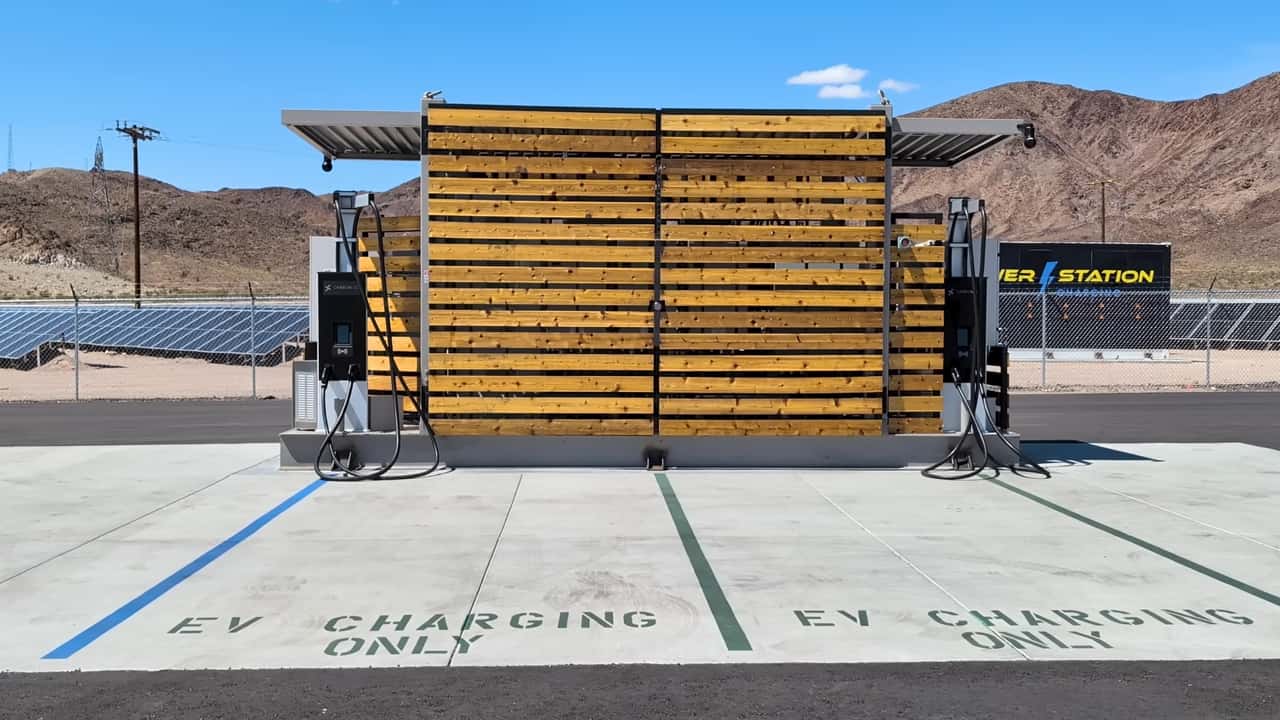
California startup PowerStation Charging debuts a solar-powered EV fast-charging station in Baker, utilizing 1,080 solar panels and a 3.4-megawatt-hour battery to deliver up to 640 kilowatts of power
The station offers free EV charging until May 31, 2026, with four CCS1 ports currently available and six NACS ports planned for later this summer, increasing shared output to 600 kW
The project reflects a growing trend of renewable-energy-powered charging stations in the U.S., with three additional solar-powered DC fast-charging stations in development across California, mirroring innovative projects like Tesla’s solar-powered Supercharger station in Lost Hills
Solar-Powered EV Charging Station Debuts in California, Offering Free Charging Until 2026
A California startup named PowerStation Charging has launched an innovative EV fast-charging station in Baker, California, that runs entirely on solar power. This groundbreaking station, located at the Rasor Road exit off I-15, boasts no grid connection. Instead, it utilizes 1,080 solar panels to generate up to 640 kilowatts of power, which is stored in a massive 3.4-megawatt-hour battery pack. This setup allows the station to operate 24/7, even when the sun isn’t shining.
YouTube personality Scott Allison recently charged his Kia EV9 at the station and shared his experience in a video. The current setup features four CCS1 charging ports with a shared output of 360 kW. Later this summer, PowerStation Charging plans to add six NACS ports, increasing the shared power output to 600 kW. An 8,000-square-foot underground bunker with a lounge and bathrooms is also under construction. The power output is dynamically divided among all charging EVs—if only one vehicle is plugged in, it enjoys the full output, but if multiple EVs are charging simultaneously, the output is split accordingly.
One of the most appealing features of this station is that it requires no app or membership to use, and charging is completely free until May 31, 2026. After this period, prices will range from $0.30/kWh to $0.45/kWh, depending on demand and solar conditions.
PowerStation Charging reveals on its website that three additional solar-powered DC fast-charging stations are in development. The second location on I-15 near Barstow is expected to open this year, with two more stations planned for 2027 on the I-10 and I-8 highways.
This initiative aligns with a broader trend in the U.S. of deploying renewable-energy-powered, battery-backed charging stations. For example, Tesla’s largest Supercharger station, opened late last year in Lost Hills, California, is entirely solar-powered. It features 11 MW of solar panels, which also serve as a canopy for the parking spots, and is supported by 10 Megapack batteries totalling 39 MWh of energy storage, capable of powering up to 164 EVs simultaneously.
Canadian Context and Incentives
While this particular station is in the U.S., Canadians can appreciate the growing trend of sustainable charging solutions. In Canada, several provinces offer incentives to make EV ownership and charging more affordable. For instance, the federal iZEV (Innovation and Zero-Emission Vehicles) program provides up to $4,000 towards an eligible EV purchase. Additionally, provincial rebates vary:
- **Ontario**: Up to $1,000 for home charging equipment through the Drive Clean Rebate Program.
- **British Columbia**: Up to $1,400 for home charging installations.
- **Quebec**: Up to $400 for wallboxes.
These incentives, combined with an increasing number of public charging stations, make EV ownership in Canada more accessible and financially viable. As the demand for EVs grows, expect to see more renewable-powered charging solutions pop up across Canada, mirroring the innovative projects in the U.S.
What Would You Like to See on InsideEVs.com?
We value your feedback! What topics or features would you like to see more of on InsideEVs.com? Your input helps us create content that matters to you.
Trending and Recommended Articles
Stay up to date with the latest in the EV world. Here are some recommended reads:
- **BYD's 10-Minute Charging Hits Europe. But The Car Isn't Cheap**
- **Tesla’s FSD Finally Approved In Europe… Sort Of**
- **‘Megawatt’ EV Chargers Have Landed In The U.S., But There’s A Problem**
- **Honda’s Cutest EV Also Has Simulated Gear Shifting**
- **Walmart’s DC Fast Charging Network Already Has Hundreds Of Ports**
- **How Can I Tell If A Car Is Reliable? An Honest Guide**
- **This New Electric Car Nearly Fills Its Battery In Under 9 Minutes**